
Sandra Wärenhed | 2026-10-08
A cardboard box has a straightforward job: contain and protect products being moved from one place to another. But what happens after the box completes that job? For a retailer, warehouse, restaurant, hotel, manufacturing facility, or other commercial operation, that moment is not the end of the box’s lifecycle. It’s the beginning of its next chapter.
Once the contents are unpacked, the first step is keeping the cardboard separate from general waste. When empty boxes are thrown into mixed waste, recyclable fiber can become harder to recover. Sorting cardboard at the source creates a cleaner material stream that can be compacted, stored, collected, and sent for recycling.
This is where operational decisions can have a direct effect on what happens next.
From Loose Boxes to Compact Bales
Empty cardboard takes up far more space than you might expect. A box is mostly air, and a steady flow of loose boxes will quickly fill a back room, loading area, stockroom, or warehouse aisle.
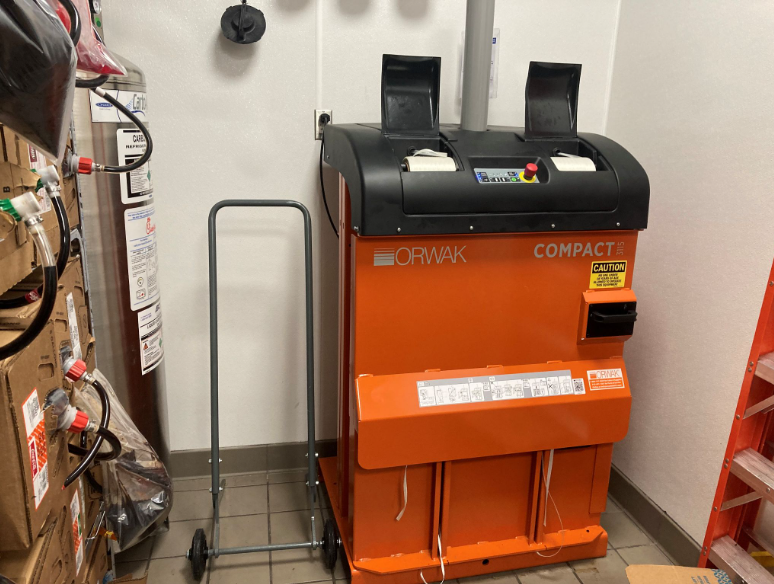
Source compaction changes that equation. Instead of storing loose cardboard until a pickup, businesses can feed separated cardboard into a baler at or near the point where the boxes are emptied. The material is compressed into a dense, manageable bale that takes up substantially less space.
Orwak machine cardboard compaction ratios are approximately 5:1 to 10:1, depending on the equipment. That means a given amount of cardboard occupies a fraction of its original volume after compaction.
The operational benefits extend beyond saving floor space. Compact bales help keep work areas cleaner and more organized, reduce the space required to store recyclables, and cut the amount of uncompacted material that has to be moved internally.
Fewer Trips, More Efficient Recycling
Compacting cardboard at the source also improves the logistics of getting that material to a recycling partner. A business that stores loose cardboard may need more frequent pickups simply because the material fills available containers so quickly. When cardboard is compacted, more material can be contained in a smaller footprint.
That means fewer waste pickups, reduced transportation costs, and lower emissions. Source sorting also produces higher-quality recyclable material, which can be a revenue source.
Once compacted, bales travel to a recycling partner and enter the next stage of the process. Recovered cardboard fiber can be processed and used as raw material for new paper and cardboard products. The original box has now progressed from packaging to recyclable material, with the potential to become part of another product.
The Baler as the Link in the Chain
It is easy to think of a baler as simply a piece of waste-handling equipment. But in a well-designed recycling process, it plays a more important role: The baler sits between “box emptied” and “box recycled,” a critical link in the chain.
That connection matters because recycling does not begin when a material reaches a recycling facility. It actually starts with what happens where the material is generated. If cardboard is separated from other waste, compacted, and prepared for collection, a business has taken a practical, efficient step toward keeping that material in the recycling stream.
Orwak offers baling and compaction solutions for different volumes and operating environments, from compact equipment for smaller cardboard streams to larger systems suited to high-volume operations. Multi-chamber solutions can also support source separation when businesses need to manage more than one recyclable material.